The agent workspace in v1.0.9
The screenshot shows a local project tree and the Files, Terminal, Planner, Memory and Checkpoints tabs. The top-right control says Write OFF, matching the default safety posture.
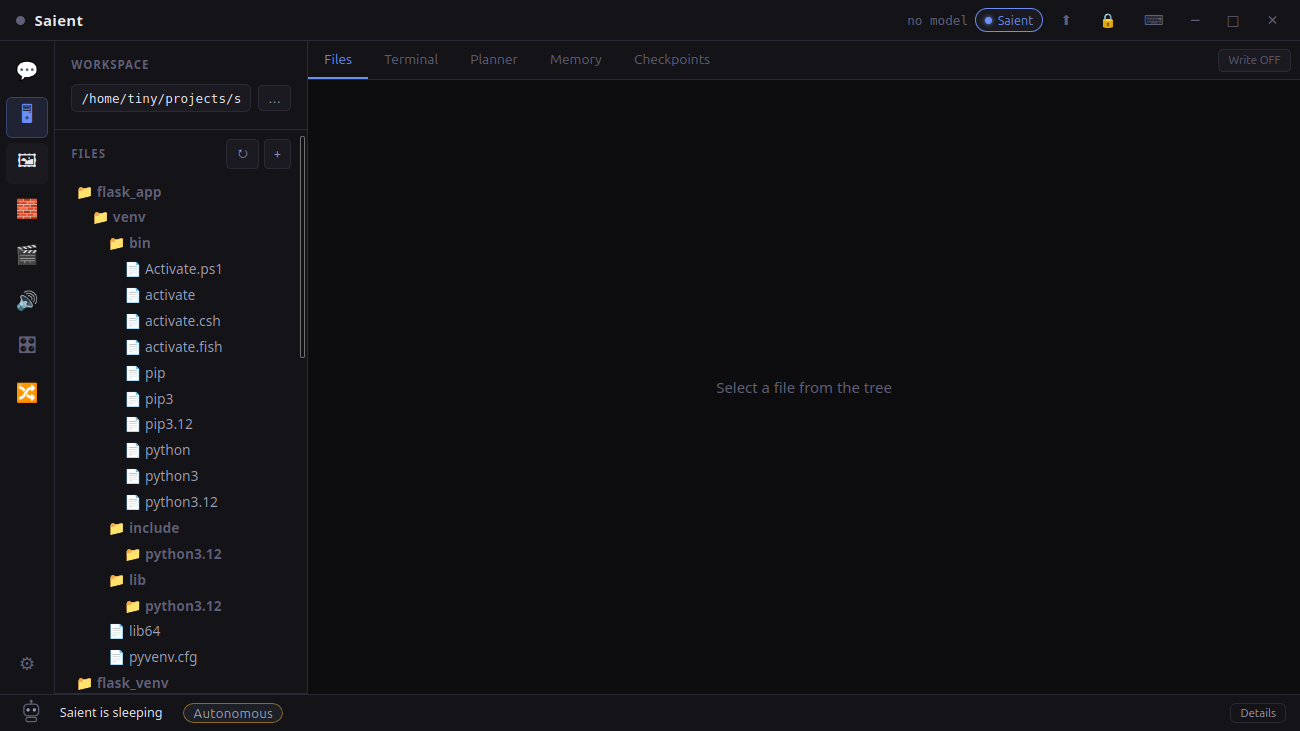
Saient agent workspace
Captured from the installed desktop app. The project path is local; no cloud IDE is shown or implied.
What Saient supplies vs what the host model supplies
| Layer | Responsibility |
|---|---|
| Local LLM host | Produces candidate plans, tool-call content, explanations and other generated text. Different models or sampling settings can change those proposals. |
| Saient state | Stores drives/goals, persistent agent state, episodic/semantic/procedural memory, checkpoints and provenance. |
| Saient control | Arbitrates proposals, selects actions, runs the autonomous loop, handles refusal/repetition recovery and records verification feedback. |
| Saient desktop bridge | Connects the runtime to the chosen project, file tools, PTY terminal, sandbox/security controls and local model server. |
Four project-level modes
- Off: a plain planning agent without Saient's autonomous objective loop.
- Guided: Saient can propose objectives while the normal agent carries them out.
- Companion: Saient runs alongside the working state and retains memory between sessions.
- Autonomous: the full loop can select goals and continue acting within the chosen project and granted tool permissions.
These levels change orchestration, not the laws of the machine. Tool permissions, project boundaries, confirmation policy and write mode still apply.
Give it a verifiable local task
- Select a project. Saient scopes file tools and project state to the chosen workspace.
- Load a local GGUF model. Choose a model that can follow structured instructions and tool schemas.
- State the goal and checks. Name the expected outcome, constraints and command/test that will prove completion.
- Grant only needed authority. Keep write mode off for inspection; enable it when you want the agent to modify files or run commands.
- Review evidence. Inspect changed files, terminal output, verification feedback, memory/provenance and checkpoints.
The agent uses the local LLM you load
The desktop agent currently uses Saient's GGUF/tinyq4 path, so supported architecture, quantisation, RAM/VRAM and context rules are the same as the local LLM guide. A larger model may improve tool following but uses more memory; this page makes no universal model-quality ranking.
What is demonstrated
The installed app rendered a real project tree, agent tabs, write control and persistent-mode indicator in the screenshot above.
The desktop bundle contains the Saient runtime and completed a one-tick local smoke test during integration.
The running local Qwen 14B server answered a controlled health/inference check on 9 August 2026.
No claim of consciousness, personhood, infallibility or universally safe autonomous behavior is made.
Continue from here
- Download Saient v1.0.9 for Debian/Ubuntu amd64.
- Choose and run a compatible local GGUF model.
- Saient setup, security and troubleshooting help.
- Read the full AI Agent Persistence research paper and evidence boundary.
- Saient release repository on GitHub.
- Compare Saient's task-focused approach with ComfyUI.
Use a local model with persistent agent machinery.
Saient is free and does not require a Saient licence or hosted inference key. You remain responsible for the project, model and permissions you select.