The current merge screen
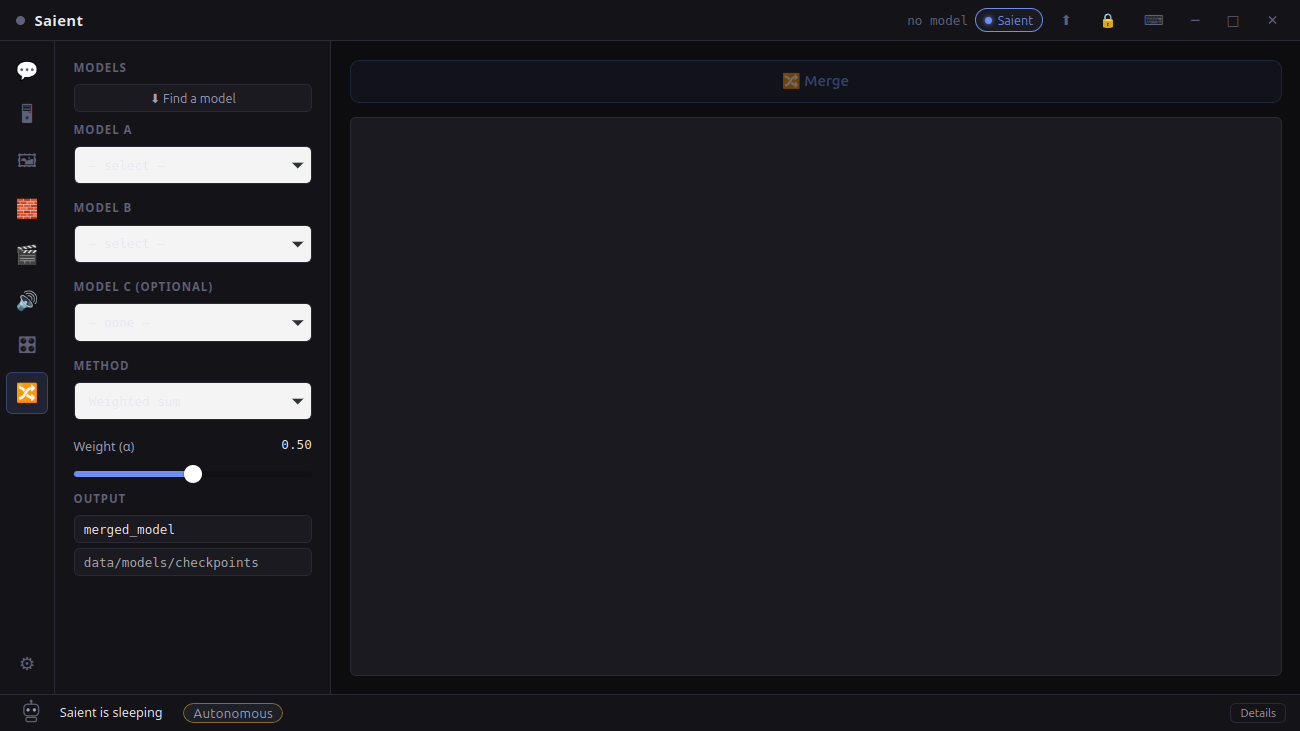
Saient Merge, v1.0.4
The screen exists and exposes both methods, but the empty selectors shown here are part of the wiring defect described below.
Do not feed GGUF files to this worker
.gguf language models. The backend merge worker expects diffusion checkpoint tensors in .safetensors, .ckpt or .pt form. The packaged GUI route is therefore not usable as advertised until its picker is corrected.This page is published because a useful local model-merging guide must distinguish an implemented worker from a working end-user path. The website will not turn the presence of a screen into a false feature claim.
What the merge worker implements
| Method | Formula | Use |
|---|---|---|
| Weighted sum | A × (1-w) + B × w | Interpolates matching tensors between two structurally compatible checkpoints. |
| Add difference | A + (B-C) × w | Applies a weighted difference between B and C onto A; model C is required. |
When a shared tensor has a different shape, the worker keeps A's tensor. Keys found only in A or only in B are copied into the output. That behavior prevents a shape exception, but it does not prove the resulting hybrid model is semantically sound.
Choose checkpoints that belong together
- Use the same architecture and closely related tensor layout—such as two checkpoints derived from the same SDXL base.
- Compare tensor-key and shape compatibility before treating a completed file as a valid model.
- Never merge a LoRA adapter as if it were a full checkpoint, and never merge GGUF language models with this diffusion worker.
- Keep the source files. A merge output is a new experiment, not a replacement for A, B or C.
- Review every source model's licence; blending weights does not remove upstream restrictions.
RAM and storage requirements
- GPU: not required by this tensor merge; it runs on CPU.
- Safetensors inputs: opened lazily, so input tensors are fetched as needed. The result still accumulates before save, making peak RAM roughly output-model scale plus working tensors.
- CKPT/PT inputs: loaded fully into RAM before merge, so they need more memory.
- Disk: keep A, B, optional C and the new output simultaneously. Use a filesystem with enough free space for a failed/retried save as well.
Implemented worker, unproven packaged route
The repository contains the two formulas, lazy safetensors access, key/shape handling, progress events, cancellation handling and safetensors output. The UI screenshot proves the screen exists. No completed merge artefact is retained in the current workspace, and the v1.0.9 picker defect blocks an honest end-to-end GUI demonstration.
What to do next
- Watch the Saient release repository for a build that corrects the picker.
- Run compatible SDXL checkpoints locally.
- Train a LoRA locally when an adapter—not a full blended checkpoint—is the right tool.
- Read Saient setup help.
Free software still needs honest release notes.
Saient v1.0.9 is free, but this specific screen has a confirmed picker defect. Use the download for its verified local features; do not install it solely for GUI checkpoint merging yet.